The idea often survives. The reasons disappear. A team can remember the moodboard, recognize the chosen color and still struggle to explain what the next piece of work is meant to achieve.
That is one gap between inspiration and execution: creative context has to cross several boundaries before anything gets made. A saved image becomes a conversation. A conversation becomes a choice. A choice becomes a task. Each handoff can lose the information that made the previous step useful.
This is not the only reason good ideas stall. Time, money, skill, disagreement and changing priorities matter. No workspace can remove those constraints. But making the chain of reasoning visible can help a team recognize what is unresolved, avoid repeating an old debate and give the next person something more useful than “make it feel like this.”
The tools are separate, and so is the context
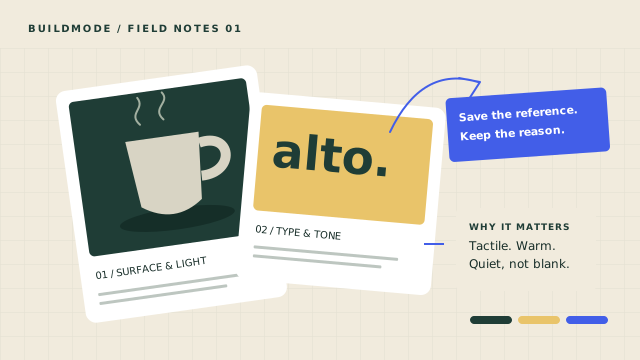
Consider ALTO, our fictional neighborhood coffee brand. Its owner saves matte ceramic cups in a reference folder, discusses a welcoming identity in a chat and adds “launch photography” to a task board. Each tool does its own job. None of those fragments, by itself, explains why the photographs should look a particular way.
The friction appears when someone has to join the pieces. Which cup image mattered? Was it the shape, the surface or the daylight? Did the team agree on a quiet identity, or was that one possibility among several? A task can be perfectly clear about its deadline while remaining vague about the intent it should serve.
The answer is not necessarily to replace every specialist tool. A photographer still needs photography tools and a printer still needs usable production files. The useful improvement is a durable connection between the reference, the interpretation and the commitment, so the next tool receives more than an isolated instruction.
A reference needs a reason to remain useful
“I like this” captures a reaction. “The matte surface and warm daylight make the cup feel tactile and approachable” captures something another person can inspect. The second note is not an objective truth about every customer. It is a specific observation and interpretation that can be discussed.
For ALTO, that distinction matters. A ceramic photograph may support a quiet visual route, but it does not establish that the café’s customers want a slow morning ritual. Keep the source, the observation and the audience assumption separate. Otherwise a visual preference can quietly become a business requirement.
BuildMode’s Library and project-reference workflow provide a place to retain inspiration and bring useful references into a project. On the Canvas, references and rationale can sit alongside the thinking they inform. The practical habit is still yours: write down why an item matters while you remember it. Our guide to organizing inspiration gives a repeatable way to do that.
Exploration needs a point of commitment
Exploring several routes is useful when the project is uncertain. ALTO could be quiet and tactile, energetic and local, or simple and dependable. More alternatives can reveal a hidden assumption or show that the first idea was only the easiest to describe.
But collecting alternatives is different from resolving them. If every promising image reopens the whole identity, exploration can become a comfortable place to avoid a difficult choice. The work grows sideways while the launch date stays where it was.
Give exploration a question and a review point. Ask which route best serves the brief, what it gives up and what small test would expose a weakness. A hypothesis remains provisional. Promoting it creates a proposed Direction; a person must explicitly accept that Direction. Neither step should be described as AI deciding what the project believes.
An accepted Direction also has limits. “Quiet morning ritual” is a shared route, not a complete instruction for every photograph, wordmark and label. Specific choices still need to be made individually. Guide 03 explores hypotheses and human acceptance, including evidence, assumptions and tradeoffs.
A conversation is not a reliable decision record
“Yes, let’s do that” may make sense in a meeting and become ambiguous a week later. What was accepted? Who had the authority to accept it? Was the statement a suggestion, a preference or a commitment? A transcript can preserve every word while leaving all three questions unanswered.
For ALTO, turn the relevant conclusion into a specific Decision: “Use warm daylight for launch photography.” Keep the reason, link it to the accepted quiet Direction and preserve the source context. Record a separate unresolved question for the shot list rather than pretending the conversation settled every detail.
BuildMode distinguishes Directions from committed Decisions so a route and a concrete choice can be represented separately. A person commits Decisions. AI exploration and Direction acceptance do not automatically commit them. The value is not another record to maintain for its own sake; it is a clear place to return when the team asks whether a choice is still intentional.
Compare the handoffs, not just the tools
The example below shows the same ALTO project in two arrangements. Switching the view changes the fictional handoffs, not the business goal. A connected workflow makes the reasoning easier to inspect; it does not guarantee the reasoning is right.
The same project, with different handoffs
Switch the view to inspect what survives between tools. These are fictional examples, not connected accounts or a live project.
Context breaks at each handoff
- 01
Saved images
A cup photograph survives. The note about warm light does not.
- 02
Chat thread
“Let’s go with this” has no clear route, approver or recorded commitment.
- 03
Task list
“Shoot launch photos” reaches production without a reason or review criteria.
The team must reconstruct the why before it can judge the work.
Notice that the connected version still contains an open question. Traceability should make uncertainty visible, rather than turn missing information into a convincing plan. If no one knows the packaging dimensions, write that down before assigning a final label layout.
Six stages that keep the why within reach
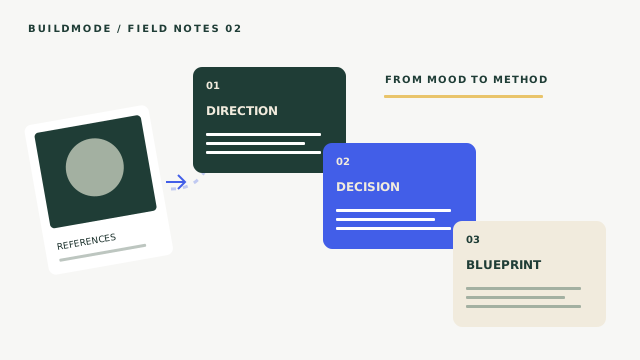
Inspiration → Explore → Direction → Decision → Blueprint → Execute is a useful map of changing responsibilities. It starts with noticing and interpreting, moves through human commitments, then translates those commitments into requirements and work. The stages need not be a one-way conveyor belt.
From a reference to a reviewable next step
This is an explanatory map, not a rigid wizard. Selecting a stage does not advance a project, approve anything or generate work.
Inspiration: Capture with context
ALTO saves a ceramic-cup reference with the note: tactile, quiet, warm.
- What carries forward
- A reference and a reason to revisit it.
- Human judgment and feature boundary
- Saving an image does not approve a creative choice.
Fixed, hand-authored examples · no API requests, project writes, approvals or committed Decisions.
At Inspiration, keep the reference and its rationale. At Explore, examine alternative interpretations. At Direction, review a proposed route and explicitly accept it if it fits. At Decision, commit a specific choice with its reason. At Blueprint, inspect principles, requirements, constraints and unanswered questions. At Execute, organize a goal, deliverables and steps that can be reviewed against the intent.
A production test can send ALTO back to an earlier stage. If warm daylight makes the package unreadable in a trial photograph, the team should revisit the shot or its constraints. A recorded Decision is something people can reconsider deliberately. It should not become an excuse to ignore new evidence.
Execution needs more than a task title
“Make the launch assets” names an output category. It does not tell the person doing the work which materials are required, what order they depend on or how the result will be judged. A useful handoff carries enough context to act without requiring someone to reconstruct the entire project.
For ALTO, break the goal into a reviewed shot list, a cup-label test and launch photographs. Identify the dependencies: packaging dimensions before the label proof, sample packaging before the shoot, an agreed reviewer before final approval. Keep the quiet, welcoming intent visible beside practical checks such as legibility and accurate product information.
Creative Blueprint and Bring to Life planning are in refinement during BuildMode’s private beta. Their planning role is to connect project context to reviewable requirements and an execution structure, including open questions. That is distinct from producing finished artwork or completing work in another application. Guide 02 follows ALTO from moodboard to plan in more detail.
Software can preserve reasoning. People still have to judge it.
BuildMode addresses this gap by connecting references, rationale, exploration, Directions and Decisions, with Blueprint and execution planning carrying that context toward work. Those connections can help someone understand a choice or notice a missing commitment. They cannot make a weak brief strong without review, settle an unresolved disagreement or know what a customer values without evidence.
AI can propose interpretations and help articulate tradeoffs. It can also produce a confident explanation for a poor idea. Check its source evidence, question its assumptions and keep approval explicit. A polished suggestion deserves examination, not automatic authority.
Automatic brand-system asset generation and external-tool integrations are future concepts or planned capabilities, separate from the workflow described here. These article simulations do not demonstrate live generation, sync or production automation. BuildMode does not replace a designer, a production specialist or the person accountable for a business decision.
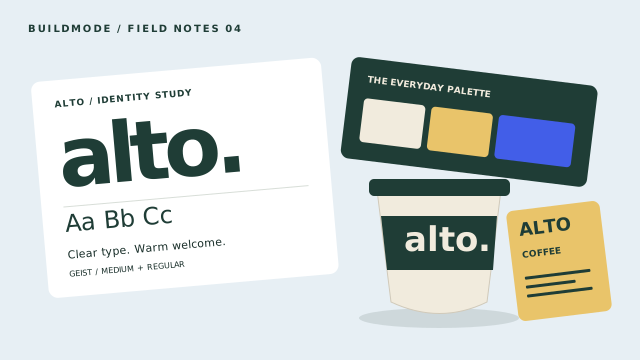
For a small business working on an identity, Guide 04 shows how to test colors, typography and simple applications. For any creative project, try a smaller audit: choose one reference, one accepted Direction and one committed Decision. Can the next person explain how they connect, what remains uncertain and what to do next?
If that chain is missing, another collection of ideas may not be the most useful next step. Reconnect one handoff. Give a task its reason, give a choice a clear status or give an assumption a test. A project starts to move when someone can carry the intent forward without having to guess what it meant.