An AI suggestion can be articulate, visually appealing and still wrong for the project. Its value is in making a possibility easier to examine. The designer still has to ask where the idea came from, what it leaves out and whether it deserves to guide the work.
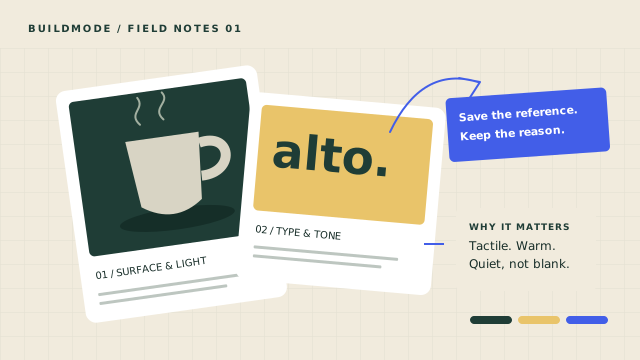
We will use ALTO, the fictional coffee brand from our earlier guides, to explore that process. ALTO wants a welcoming neighborhood identity, packaging guidance and launch photography. Its references include matte ceramic cups, warm light, restrained greens, condensed posters and readable wordmarks. There is enough variety for several plausible routes, and enough uncertainty to make human judgment necessary.
If you are starting with scattered images, first organize your references and their rationale. If you already have a Direction, Guide 02 explains how to turn explicit Decisions into a project plan. This guide concentrates on the exploratory space before those commitments.
Give AI a project, not just a style prompt
“Make this premium” leaves a model to guess what premium means, who the work is for and where it will appear. Give it a useful boundary instead: what ALTO is trying to achieve, which references you selected, the qualities you noticed and the constraints the work must respect.
For ALTO, the brief might say: introduce a welcoming coffee brand with a calm, tactile tone; keep the identity readable on a cup; connect launch photography to the physical café experience. Include reference notes such as “the ceramic surface feels quiet and unbranded” or “this poster creates hierarchy at a distance.” Those observations give exploration something more specific to respond to than an unexplained image collection.
Separate established context from unknowns. ALTO’s packaging dimensions, final approver and audience preferences may still be unresolved. Mark them as questions. A model can propose how a route might work under an assumption, but it should not turn that assumption into a client requirement without review.
Treat the output as provisional hypotheses
A hypothesis is a possible interpretation of the project context. “Quiet morning ritual” might connect the ceramics, warm light and deep green. “Neighborhood energy” might connect the poster typography and asymmetric menu. “Everyday clarity” might prioritize the readable wordmark and simple application rules.
These are alternatives to compare, not three instructions to apply at once. Ask what each route emphasizes, which part of the brief it serves and what it would mean for the work. A useful hypothesis is specific enough to challenge: “a restrained identity with warm photography” gives you more to evaluate than “a timeless brand.”
Do not read fluent wording as a confidence score. A model can produce a convincing rationale from weak context. If the explanation does not connect to an actual reference, project intent or constraint, treat it as a new suggestion to investigate rather than evidence that the route is right.
Follow the source evidence
Check the chain between a reference and the interpretation. A photo may show warm light and soft shadows. It does not establish that customers prefer a slow morning experience. The visual observation is evidence; the audience claim is an inference that needs a different kind of support.
For ALTO, a source-aware explanation could say that the ceramics and daylight share a tactile, quiet quality. It should still identify “customers value an unhurried ritual” as an assumption. Keeping those statements separate makes it easier to disagree with one without throwing away the other.
Source links are a way back to context, not a guarantee that the reasoning is sound. Open the referenced item, check that the described feature is actually present and consider whether a counterexample matters. A condensed poster may support an energetic route while conflicting with the calmer tone of the brief.
Make assumptions and tradeoffs visible
Ask every route to name something it might give up. A quiet identity could feel tactile up close but struggle on a busy street. Expressive typography could make café announcements lively but reduce readability on small packaging. A simple system could be easy to maintain while lacking distinction from nearby coffee brands.
Turn those tradeoffs into modest tests. Set the proposed wordmark at cup size. Put a draft storefront sign beside a busy street photograph. Ask the team which applications they will need to maintain. These checks can expose a mismatch before a route acquires the momentum of an approved design.
Keep the tests proportional to the uncertainty. An unknown audience preference may call for a conversation with intended customers; a spacing question may only need a quick typographic study. AI can help you articulate the question, but a plausible answer in a chat is not the result of doing the test.
Compare three routes for ALTO
The simulation below keeps the same project context across three hypotheses. Inspect each route’s reasoning, source observations, assumption and tradeoff. Then promote one into a proposed Direction. Acceptance is a separate button and a separate state.
Three hypotheses. Your judgment.
Launch a welcoming neighborhood coffee brand. Explore identity, packaging guidance and photography. Keep small-format legibility in view; audience preferences and production ownership remain open questions.
Hand-authored examples representing possible AI hypotheses. No AI call, project write or asset generation occurs.
Quiet morning ritual
- Why this route might fit
- The ceramic surface and warm-light references share a slower, physical tone. A restrained palette could connect the identity and photography without adding visual noise.
- Source evidence
- REF-1 · Matte ceramic cupsSoft surface texture and a simple silhouette.
- REF-2 · Warm morning lightGentle shadows and a warm color cast.
- REF-3 · Deep green paletteOne dominant green with a smaller golden accent.
- Assumption to check
- ALTO's customers value an unhurried coffee ritual. The brief suggests a welcoming tone; it does not prove that audience preference.
- Tradeoff and practical test
- A quiet identity may feel considered at close range but have less impact on a busy street. Test small-format legibility and a storefront application.
- Open question
- Does the calm route still feel welcoming and recognizable at a distance?
Create a proposed Direction
Promote the inspected hypothesis for a separate human review. Promotion does not accept it.
No proposed Direction yet
Inspect the alternatives and promote one before accepting a Direction.
No Direction promoted · 0 Decisions committed
Inspecting another hypothesis does not change the Direction already promoted. Accepting a Direction never commits Decisions. Reset to explore a different approval path. All changes stay in this local simulation.
Try promoting the quiet route and then inspecting a different hypothesis. The proposed Direction stays attached to the route you promoted. Looking at a new possibility should not silently replace the thing being reviewed. Reset the example if you want to follow another path from promotion to acceptance.
Keep promotion and approval separate
In BuildMode’s exploration flow, a hypothesis can be promoted as a proposed Direction with its source context. “Proposed” means it is ready for a person to evaluate; it does not mean the project has accepted it. Human acceptance is the step that records approval of the Direction.
Accepting “Quiet morning ritual” still does not commit every possible choice within it. “Use warm daylight for launch photography” and “set the wordmark in a rounded sans” are separate Decisions a person can make and link to that Direction. Neither promotion nor acceptance should be described as AI committing those Decisions on your behalf.
A responsible review can end with a question, a revision or no acceptance at all. If the route depends on an untested audience assumption or a missing production constraint, preserve that uncertainty. You do not need to approve a polished suggestion just to keep the project moving.
Building an identity yourself? Our small-business branding guide applies these ideas to colors, typography and practical applications.
Carry the reasoning into the next stage
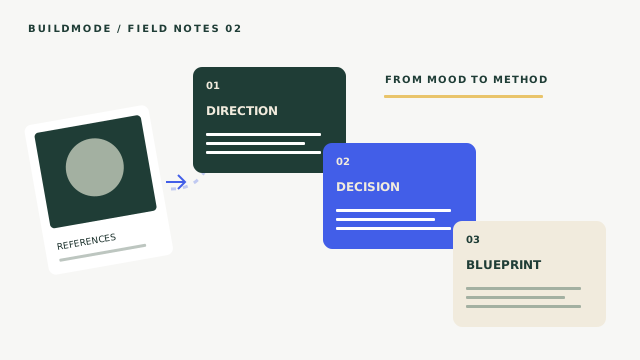
Once you have accepted a Direction, translate the choices you can defend into explicit Decisions. Keep the references and rationale attached, then review how a Creative Blueprint turns project context into principles, requirements, constraints and open questions. An execution plan can organize deliverables and steps around a specific goal.
Those planning stages still require review and are in refinement during private beta. They should not be confused with automatically producing a finished brand system, generating photographs or sending work into other tools. Asset-generation concepts and planned integrations are separate from the approval process described here.
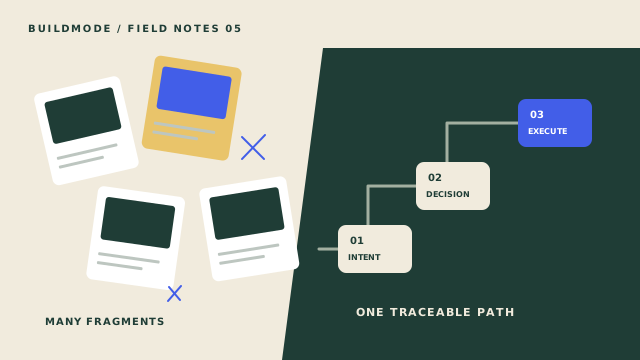
For ALTO, the practical outcome is a more explainable route through the work: several possibilities examined, a Direction deliberately accepted and Decisions made individually. Continue with From Moodboard to Creative Project Plan to see how that reasoning becomes a traceable plan.